


 PLATFORM UPDATE:


Biomineralization-mimicking cooperative assembly for tailoring anisotropic hierarchically porous metal–organic frameworks

Abstract
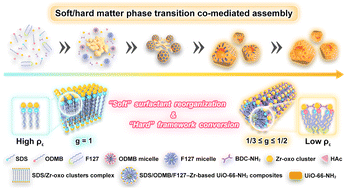
Anisotropic hierarchically porous metal–organic frameworks (MOFs) with asymmetric morphologies hold great promise for improving the utilization efficiency of the MOF matrix, thereby expanding their applicability. However, imparting MOFs with precisely controlled porous architectures and morphologies remains challenging. Here, an ingenious soft/hard matter phase transition co-mediated assembly strategy is developed to mimic the biomineralization process for synthesizing anisotropic UiO-66-NH2 mesoporous nanobowls (UiO-66-NH2 mesoNBs). This process relies on in situ generated amorphous lamellar anionic surfactant/Zr-oxo cluster complexes as metal sources and templates. This is followed by the slow decomposition of complexes and the co-assembly of ternary mixed micelles and MOF precursors on their surfaces, creating crystalline UiO-66-NH2 mesoNBs with cylindrical mesochannels. The phase transition from lamellar to cylindrical mesophases is co-driven by changes in the packing parameters caused by the “soft” surfactant reorganization and variations in the charge density of the “hard” framework during crystallization from amorphous Zr-oxo clusters to the crystalline MOF matrix. By varying the surfactant ratios, UiO-66-NH2 can form diverse novel nanostructures and achieve well-tailored pore sizes within the small mesoporous range. This work provides fundamental insights into the transformation processes in amphiphilic molecule-directed MOF biomimetic mineralization and offers a promising strategy for constructing anisotropic hierarchically porous MOFs with high structural tunability.
 Please wait while we load your content...


