


 PLATFORM UPDATE:


Electronic and energy descriptors for SACs as tri-functional catalysts towards urea formation and unveiling the C–N coupling mechanism
 *ac
*ac
Abstract
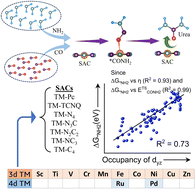
Single atom catalysts (SACs) have rapidly emerged as a cutting-edge trend in electro-catalysis for synthesizing nitrogen-based products such as ammonia, nitric acid and urea. In the present study, we considered NO2− as a specific N-based molecule, which participated in the simultaneous reduction with CO2 towards urea formation for 77 SACs. Our investigation demonstrates that among possible nitrogen-containing intermediates generated during the simultaneous electrochemical reduction of CO2 and NO2−, only the NH2 intermediate effectively couples with CO to form urea. In the case of simultaneous reduction towards urea formation, the NH2 free energy serves as an effective energy descriptor for identifying suitable catalysts, exhibiting a strong linear correlation with the limiting potential (R2 = 0.93). Additionally, we observed a strong Brønsted–Evans–Polanyi (BEP) relationship (R2 = 0.99) between the NH2 adsorption energy and the activation energy of the coupling intermediate (CONH2). Furthermore, the out of plane d-sub orbitals (dxz, dyz and dz2) of the transition metal (TM) were analysed to uncover the electronic origins of urea reactivity. Owing to the strong interaction between the d-sub orbitals of the TM and the sp3 hybrid orbitals of NH2, occupancy of the dyz orbitals plays a significant role in determining catalytic activity. This is evidenced by a linear correlation (R2 = 0.73) between orbital occupancy of dyz and NH2 adsorption energy for all systems, identifying it as the electronic origin of urea reactivity. Our interpretation regarding the descriptor is that NH2 sp3 (HOMO) donates a σ-electron to the TM d-orbital (LUMO), while the TM d-orbital (HOMO) donates a π*-electron back to NH2 sp3 (LUMO).
 Please wait while we load your content...


