


 PLATFORM UPDATE:

Phenphosphine-X(O, S, Se) locking multi-resonance thermally activated delayed fluorescence materials
 a
and
You-Xuan
Zheng
*a
a
and
You-Xuan
Zheng
*a
Abstract
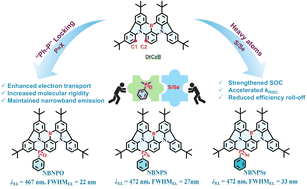
Multi-resonance thermally activated delayed fluorescence (MR-TADF) materials with narrowband emission and high efficiency are crucial for achieving ultra-high-definition displays. However, organic light-emitting diodes (OLEDs) based on MR-TADF emitters suffer from severe efficiency roll-off. Herein, we employ a phenphosphine-X(O, S, Se) locking strategy with heavy atoms to accelerate the reverse intersystem crossing (RISC) process. Three emitters NBNPO, NBNPS, and NBNPSe exhibit blue emission peaking at 468–471 nm with a full-width at half-maximum of 19 nm (0.11 eV) in toluene. The doped films show photoluminescence efficiencies of up to 95% with RISC rate constants as high as 5.92 × 10⁴, 4.62 × 10⁵, and 9.91 × 10⁶ s−1 for NBNPO, NBNPS, and NBNPSe, respectively. The corresponding OLEDs achieve maximum external quantum efficiencies of up to 32.4% with gradually decreased efficiency roll-off. These findings highlight a promising molecular design strategy for efficient MR-TADF materials and OLEDs.
 Please wait while we load your content...


