


 PLATFORM UPDATE:


Uncovering outer-sphere mechanisms governing chemoselectivity in copper-photocatalyzed ATRA reactions of CF3SO2Cl with alkenes
 b
and
Alireza
Ariafard
*b
b
and
Alireza
Ariafard
*b
Abstract
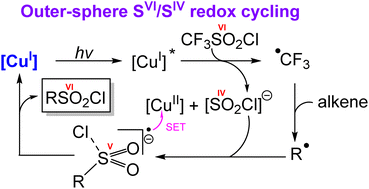
This work presents a detailed DFT-based mechanistic investigation of copper-photocatalyzed atom transfer radical addition (ATRA) reactions between CF3SO2Cl and alkenes. Depending on the electronic nature of the alkene substrate, these reactions yield either RCl or RSO2Cl products. The unusual divergence in product selectivity has led to the proposal of multiple mechanistic pathways. In this study, we show that all productive pathways proceed exclusively via outer-sphere single-electron transfer and identify two previously unrecognized mechanisms: an S(VI)/S(IV) redox cycling mechanism responsible for RSO2Cl formation, and a 2c–3e Cl-coordination-induced SET mechanism accounting for RCl formation. These two pathways represent the first models to explicitly demonstrate the bifunctional role of the [SO2Cl]− anion in governing divergent product formation. Additionally, we identify a third, cationic mechanism, in which the carbon-centred radical is oxidized to a carbocation by Cu(II), competing with the other pathways and likewise leading to RCl. Taken together, these results provide a useful framework for understanding chemoselectivity in this class of photocatalytic transformations and may help guide the design of future ATRA protocols.
 Please wait while we load your content...


