


 PLATFORM UPDATE:


Polyterrylenes: synthesis and regioregularity effect on p-type charge transport and deep-red light photodetection in OFETs
 †a
Minji
Chung,
†b
Hayeong
Park,
b
Ullrich
Scherf,
c
Joon Hak
Oh
*b
and
Suman Kalyan
Samanta
*a
†a
Minji
Chung,
†b
Hayeong
Park,
b
Ullrich
Scherf,
c
Joon Hak
Oh
*b
and
Suman Kalyan
Samanta
*a
Abstract
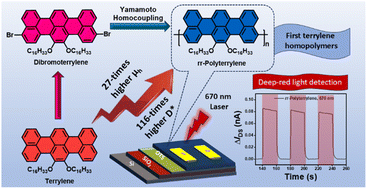
Polymers of higher rylene dyes remain largely unexplored despite their promising photophysical properties, due to the synthetic challenges and poor solubility, in contrast to their well-studied lower homologs, perylene and naphthalene derivatives. In this study, we report the first synthesis of terrylene-based regioregular and regioirregular homopolymers, namely rr-Polyterrylene and ri-Polyterrylene, respectively. Selective bromination of our previously synthesized 7,8-bis(hexadecyloxy)terrylene (TER-C16) furnished the corresponding dibromoterrylene. Then, Ni(0)-mediated Yamamoto homocoupling reaction produced the first soluble terrylene-based homopolymers. Both polymers achieved high solubility, high thermal stability, alongside very high molecular weight. Owing to these properties, the polymers were successfully deployed in organic field-effect transistors (OFETs), achieving p-type mobility 27 times higher than the monomeric unit TER-C16. Moreover, the photoresponsive OFETs from rr-Polyterrylene demonstrated 116-times improved photodetection ability compared to TER-C16 with specific detectivity (D*) of 4.3 × 10¹⁰ Jones in the deep red region, which is the highest among terrylenes and their derivatives. This work introduced the synthesis of dibromoterrylene, a versatile synthetic intermediate with significant potential for constructing diverse polymers. The strategic functionalization of terrylene molecules revealed a novel synthetic approach, enabling innovative polymer construction and facilitating significant advances in organic electronics, specifically OFETs and organic phototransistors (OPTs).
 Please wait while we load your content...


