


 PLATFORM UPDATE:


Peptide ligand isomerism drives divergent stability and guest binding in Pd3L4 metal-peptidic cages

Abstract
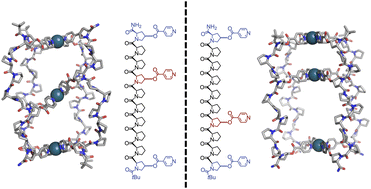
The self-assembly of metal–organic cages enables the rapid creation of atomically defined, three-dimensional, nanoscale architectures from easily accessible building blocks. Rigid and flat aromatic panels are typically used as ligands, but limit the diversity and aqueous solubility of cages thus formed. Building on our recent success using oligoprolines to create defined metal-peptidic Pd2L4 cages with emergent head-to-tail isomer control, we now show that installation of an additional metal-binding motif enables formation of a new family of Pd3L4 dual-cavity anisotropic ‘peanut’ cages. Using automated solid-phase peptide synthesis enables generation of a ligand series by varying sequence isomer and/or the stereochemistry of the 4R/S-hydroxyproline. Small differences in ligand isomerism generate four distinct self-assembly outcomes, forming: the Pd3L4cis CCNN cage isomer, the Pd3L4 ‘All Up’ CCCC cage isomer, a mixture of all possible isomers of Pd3L4 cages, or an interpenetrated Pd6L8 cage. Finally, these subtle alterations in cage structure led to differing host–guest interactions and strikingly divergent stability profiles for the metal-peptidic cages when exposed to a range of stimuli. Certain isomers remain stable to base for more than six days, while others fully degrade within an hour. This work underscores the advantages of using biological building blocks in supramolecular chemistry to create systems with tuneable properties.
 Please wait while we load your content...


