


 PLATFORM UPDATE:


Cooperative borane activation by tuning hemilability of different Os-κ2-N,Se-chelated complexes
 *a
and
Sundargopal
Ghosh
*a
*a
and
Sundargopal
Ghosh
*a
Abstract
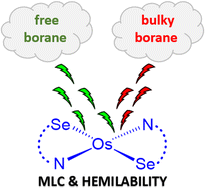
In an effort to investigate the cooperative activation of boranes, we have designed Os(III) based paramagnetic mono- and bis-κ2-1,3-N,Se-chelated complexes, [Os(PPh3)2(κ2-N,Se-L)Cl2], 1 and [Os(PPh3)(κ2-N,Se-L)2(L′)], 2–3 (L = C5H4NSe; 2: L′ = Cl and 3: L′ = κ1-Se-L). These complexes were synthesised by the thermolysis of [Os(PPh3)3Cl2] with the potassium salt of 2-selenopyridine, which also afforded a diamagnetic species, [Os(PPh3)2(κ2-N,Se-L)2], 4. A comprehensive study utilizing EPR spectroscopy, DFT calculations, and both photochemical and electrochemical analyses has elucidated the distinctive electronic characteristics of these complexes. To probe the electronic influence on hemilability, the OsNCSe osmaheterocycle-based paramagnetic complexes featuring a hard Os(III) centre and a soft Se donor were studied for B–H activation, highlighting synergistic hemilability and metal–ligand cooperativity. Treatment of 2 with [BH3·SMe2] yielded the Os(dihydridoborate)(octatrihydridoborate) complex, [Os(PPh3)(κ3-H,H,N-BH3L)(κ2-H,Se-B3H7L)] (5) via ring opening of both Os–Se and Os–N bonds and the Os–borallyl complex, [(PPh3)(H)2Os(η5-B3H5L2)] (6) through cleavage of the Os–N bonds. To further assess steric effects on cooperative borane activation, 2 was treated with the bulky aryl-substituted borane BH2R (R = (CF3)2C6H3), which afforded [(PPh3)Os{κ3-H,Se,Se′-(NHRBSeBHRN)(SeC5H4)2}], 7via dual Os–N bond cleavage and insertion of two BHR units followed by B–Se bond formation. Interestingly, we have isolated a unique vertex-fused metallaborane cluster, 8 from the reaction of 6 with an excess of borane. In stark contrast, the diamagnetic bis-κ2-1,3-N,Se-chelated complex [Os(PPh3)2(κ2-N,Se-L)2], 4 exhibited no tendency to activate sterically demanding boranes. However, using an electronically distinct ligand framework in [Os(PPh3)2(κ2-N,S-C7H4NS2)2] (4mbz), we observed notable B–H activation patterns of BHR2 that led to the isolation of the Os(σ-borate) complex, [Os(PPh3)2(κ2-N,S-C7H4NS2)(κ3-H,S,S′-HBR2(C7H4NS2))] (11), where the steric hindrance from the aryl substituents prevented dual-site activation. The bonding insights of these activated species were investigated on the basis of DFT calculations.
 Please wait while we load your content...


