


 PLATFORM UPDATE:


Organic cation conformational flexibility governs mechanical response in organic–inorganic hybrid materials
 b
Qiong
Ye
*a
b
Qiong
Ye
*a
Abstract
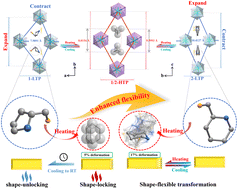
Organic–inorganic hybrids, that couple the structural design flexibility of organics and the rigidity of inorganic lattices, are gaining attention as next-generation stimuli-responsive materials for adaptive actuation applications. Understanding and controlling mechanical responses in organic–inorganic hybrids is vital for the development of smart materials. Herein, we designed and introduced five- and six-membered ring cations with distinct conformational rigidities to obtain two hybrid metal-halide crystals, (Hmpy)PbI3 (1, Hmpy = 2-hydroxymethyl-pyrrolidinium) and (Hmpi)PbI3 (2, Hmpi = 2-hydroxymethyl-piperidinium). Compound 1 exhibits a moderate reversible deformation of 5% with pronounced shape-locking. In contrast, compound 2 shows a large reversible deformation up to 17%. Structural and variable-temperature Raman analyses establish the adaptability of organic cations as the governing factor for ferroelastic strain modulation, operating through controlled ring dynamics and lattice slippage mechanisms. These results establish a clear structure-mechanics relationship: conformational rigidity promotes shape-locking, while enhanced conformational flexibility enables greater actuation freedom. Decoding the structural code behind mechanical response offers a rational basis for designing adaptive crystals with shape memory function.
 Please wait while we load your content...


