


 PLATFORM UPDATE:


Pd–Cu dual-site tuned H adsorption for efficient electrocatalytic hydrogenation of HMF

Abstract
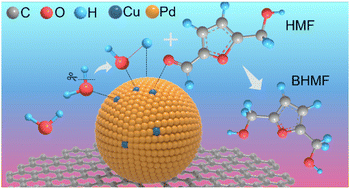
Electrocatalytic hydrogenation (ECH) of 5-hydroxymethylfurfural (HMF) to 2,5-bis(hydroxymethyl)furan (BHMF) is regarded as a green synthesis strategy for generating high quality bio-based chemicals. However, simultaneously regulating both the hydrogen (H) coverage and the adsorption behavior of HMF presents a significant challenge, particularly in unraveling the intricate structure–activity relationship and achieving a selective target product. Here, we enhance the availability of hydrogen (H*) and modulate surface electronic interactions with 5-hydroxymethylfurfural (HMF) to facilitate selective electrochemical hydrogenation (ECH) of HMF by introducing palladium as an auxiliary component. Pd–Cu dual sites synergistically enhanced H* supply and HMF activation while suppressing the competing hydrogen evolution reaction. The optimized electrocatalyst exhibits notable catalytic performance, attaining a selectivity of 99.3% and a faradaic efficiency of 97.5% for BHMF at a potential of −1.15 V (vs. Ag/AgCl). Density functional theory (DFT) calculations demonstrate that Pd doping is crucial for enhancing the adsorption of H* and HMF* intermediates, thereby promoting the hydrogenation of HMF through the Langmuir–Hinshelwood (L–H) mechanism under neutral conditions. This work establishes a catalyst design paradigm where atomic-level dopant engineering regulates multistep protonation kinetics, offering fundamental insights into biomass electrorefining.
 Please wait while we load your content...


