


 PLATFORM UPDATE:


Broad-spectrum rejection of emerging organic contaminants with different structures and properties from complex water matrices by a chlorine-resistant Janus nanofiltration membrane
 *a
and
*a
and
Abstract
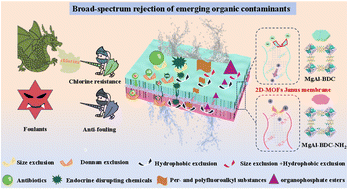
Emerging organic contaminants (EOCs) are causing a global water safety crisis and pollution, while conventional nanofiltration membranes with negative charge are inadequate to remove positively charged EOCs, and their poor chlorine resistance strongly hinders their performance. Herein, Janus membranes (JMs) were tailored to reject EOCs with different structures and properties by firmly incorporating two-dimensional metal–organic frameworks (2D-MOFs) with different sizes and charge characteristics into a chlorine-resistant and porous polyvinylidene difluoride matrix. By adjusting the ligand substitution and synthesis temperature, the pore size, charge and hydrophilicity of the 2D-MOFs were controllably modulated to impart the membranes with high permeability and broad-spectrum removal of positively and negatively charged EOCs (antibiotics, endocrine disrupting chemicals, per- and polyfluoroalkyl substances, and organophosphate esters). The JMs presented superior separation performance compared to single-sided and state-of-the-art nanofiltration membranes owing to the electrostatic Janus structure, and porous and hydrophilic nature of the 2D-MOFs. Notably, the JM200 membrane demonstrated exceptional water permeability (55.6 L per m2 per h per bar) and rejection of tobramycin, 3,3,5,5-tetrabromobisphenol A, heptadecafluorononanoic acid and tris(2-phenylphenyl)phosphate (over 99.9%). Additionally, the JM200 membrane exhibits outstanding antibiotics/salt selectivity (separation factor of tobramycin/NaCl = 152), anti-fouling, chlorine resistance (chlorine exposure of 400 000 ppm min) and stability, delivering superior performance compared to the commercial NF270 membrane during long-term treatment of real surface water and municipal wastewater. This study opens a sustainable avenue for ultrafast and broad-spectrum removal of EOCs from complex water matrices with low energy and chemical consumption.
 Please wait while we load your content...


