


 PLATFORM UPDATE:


Poly(beta-amino esters): applications in immunology
 abc
Rafał J.
Kopiasz,
ad
Amr
Elsherbeny,
ace
Pratik
Gurnani
f
and
Cameron
Alexander
*a
abc
Rafał J.
Kopiasz,
ad
Amr
Elsherbeny,
ace
Pratik
Gurnani
f
and
Cameron
Alexander
*a
Abstract
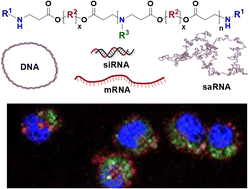
The immune system is critical in safeguarding human health against a variety of external and internal threats, yet its dysregulation can lead to serious diseases such as autoimmune disorders and cancers. However, recent years have witnessed notable progress in immunotherapeutic interventions, including the development of novel modalities such as messenger RNA and DNA vaccines, immunotherapies using immune checkpoint inhibitors, and personalised dendritic cell vaccines. To optimise the delivery of these promising therapies, there is a growing interest in understanding how to target efficiently immune cells and immune-rich organs. Among the various delivery systems explored, synthetic polymers have emerged as versatile platforms, offering tuneable properties to modulate the immune system effectively. Poly(beta-amino esters) (PBAEs), characterised by their pH-dependent degradability and nanoparticle-forming capabilities, have gained significant attention as a promising delivery system in immunotherapy, immune-oncology, and vaccination. This review evaluates recent advances and applications of PBAEs in immunology. Beginning with an overview of synthetic methodologies, we cover their utilisation for nucleic acid, small molecule, and protein delivery, addressing therapeutic challenges associated with the immune system. We explore the diverse monomer chemistries employed in these applications and evaluate PBAEs in cutting-edge approaches such as mRNA and DNA vaccines, cancer immunotherapies, and immune cell reprogramming. By evaluating existing literature, this review aims to provide insights into the potential of PBAEs in immunotherapy while defining future directions for exploration in this rapidly evolving field.
- This article is part of the themed collection: 2026 Chemical Science Perspective & Review Collection
 Please wait while we load your content...


