Biological semiconductors: self-assembled shell proteins as photoactive materials

Abstract

Light-harvesting proteins are promising biocompatible materials for bioelectronics, yet their instability and inefficient charge transport hinder direct integration. External scaffolds offer support but introduce energy losses and delay response. Here, we identified a class of hyper-thermostable, self-assembling bacterial shell proteins that form disc-like structures with spatially organized tyrosine residues, facilitating efficient light absorption and charge transport. IV profiling and ultraviolet photoelectron spectroscopy reveal their semiconducting behavior and low work function (<3 eV). These protein discs generate photocurrents under UV illumination without external bias and achieve external quantum efficiencies (∼0.5%) and response times (0.3 s) surpassing those of traditional photosynthetic proteins by an order of magnitude. Mutational analysis implicates a tyrosine-mediated electron transfer mechanism. These findings establish bacterial shell proteins as intrinsically stable, scaffold-free photoactive materials for next-generation bioelectronic applications.
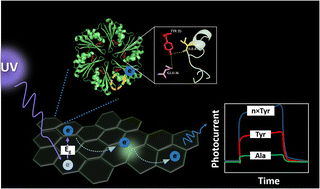
Graphical abstract: Biological semiconductors: self-assembled shell proteins as photoactive materials

Supplementary files

Article information

Article type
Edge Article
Submitted
30 Jul 2025
Accepted
12 Nov 2025
First published
13 Nov 2025
This article is Open Access

All publication charges for this article have been paid for by the Royal Society of Chemistry
Creative Commons BY-NC license

Chem. Sci., 2026, Advance Article

Biological semiconductors: self-assembled shell proteins as photoactive materials

S. Bedi, S. M. Rose and S. Sinha, Chem. Sci., 2026, Advance Article , DOI: 10.1039/D5SC05716G

This article is licensed under a Creative Commons Attribution-NonCommercial 3.0 Unported Licence. You can use material from this article in other publications, without requesting further permission from the RSC, provided that the correct acknowledgement is given and it is not used for commercial purposes.

To request permission to reproduce material from this article in a commercial publication, please go to the Copyright Clearance Center request page.

If you are an author contributing to an RSC publication, you do not need to request permission provided correct acknowledgement is given.

If you are the author of this article, you do not need to request permission to reproduce figures and diagrams provided correct acknowledgement is given. If you want to reproduce the whole article in a third-party commercial publication (excluding your thesis/dissertation for which permission is not required) please go to the Copyright Clearance Center request page.

Read more about how to correctly acknowledge RSC content.

Social activity

Spotlight

Advertisements