


 PLATFORM UPDATE:

Rate and mechanism of thiolate deligation in Au25 nanoclusters via in operando electrochemical impedance spectroscopy
 a
Samuel D.
Parker,
a
Dylan P.
Tietje-Mckinney,
a
Miguel
Orozco,
a
Trevor W.
Hayton
a
and
Lior
Sepunaru
*a
a
Samuel D.
Parker,
a
Dylan P.
Tietje-Mckinney,
a
Miguel
Orozco,
a
Trevor W.
Hayton
a
and
Lior
Sepunaru
*a
Abstract
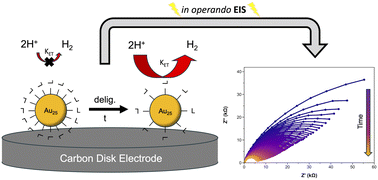
Nanomaterial electrocatalysis is a critical field for advancing sustainable energy technologies, yet determining the active catalytic species remains a significant challenge as the active species is often a result of dynamic structural evolution of the catalyst during the reaction. In this work, we investigate reductive deligation, a well-known activation process of ligated nanomaterials, on [Au25(PET)18]− (PET = 2-phenylethanethiol) nanoclusters (Au25) under varying electrochemical conditions. We introduce a novel application of electrochemical impedance spectroscopy (EIS) to characterize the Au25in situ throughout the reductive deligation process, which we term in operando EIS. This approach enables real-time monitoring of ligand removal by extracting key parameters such as the charge-transfer resistance. By systematically varying applied potential and pH, we gain kinetic and mechanistic insight into Au25 deligation and provide experimental evidence that protons play an important role in this transformation. Ultimately, this study establishes in operando EIS as a powerful electrochemical characterization tool for monitoring in situ catalyst evolution and deepens our understanding of Au25 deligation behavior.
 Please wait while we load your content...


