


 PLATFORM UPDATE:


Alkaline electrocatalytic water oxidation by Fe–Ni nanostructures on porous turbostratic carbon with tailorable metal–metal active sites
 a
Chung-Li
Dong,
c
Richard F.
Webster,
d
Chi-Liang
Chen,
e
Peng
Bai,
b
Richard M.
Tilley,
df
Nianqiang
Wu
*b
and
James J.
Watkins
*a
a
Chung-Li
Dong,
c
Richard F.
Webster,
d
Chi-Liang
Chen,
e
Peng
Bai,
b
Richard M.
Tilley,
df
Nianqiang
Wu
*b
and
James J.
Watkins
*a
Abstract
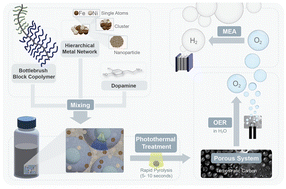
Metal ensembles on carbon supports enhance electrocatalysis by requiring close metal–metal proximity, but controlling their clustering remains difficult with current synthesis methods. This study presents a one-step high-throughput synthesis using a bottlebrush block copolymer (BBCP) template, dopamine, and metal precursors (Fe and Ni salts), which can generate high metal loadings (4 at%) of bimetallic Fe–Ni nanostructures with a reduced metallic oxidation state. The BBCP template and polymerized dopamine create a porous carbon matrix upon carbonization. Rapid photothermal pyrolysis, a photonic curing technique, carbonizes samples in seconds, creating uniform Fe–Ni active sites with reduced time and low cost. The short time scales of carbonization and metal precursor reduction favor high metal dispersion, small cluster formation, and the reduced metal oxidation state, all crucial for catalyst performance. In oxygen evolution reaction (OER) testing, the Fe–Ni/N–C catalyst showed a 130 mV overpotential at 10 mA cm−2 and a Tafel slope of 40 mV per dec in 1 M KOH. Tailorable Ni–Fe active sites enable high activity and stability, achieving 100 mA cm−2 at 1.75 V in 1 M KOH at 80 °C with an alkaline membrane electrode assembly (MEA). The unique synthesis approach enables rapid, large-scale production of high-performance electrocatalysts with tunable metal–metal sites, advancing sustainable fuel generation.
 Please wait while we load your content...


