


 PLATFORM UPDATE:


Triple-helical aggregates of copper(i) cyclic trinuclear complexes for circularly polarized luminescence
 †a
Hu
Yang,
†a
Ri-Qin
Xia,
a
Kun
Wu,
a
Yong-Liang
Huang,
b
Weigang
Lu,
*a
Ji
Zheng,
*a
Xiao-Ping
Zhou
*a
and
Dan
Li
*a
†a
Hu
Yang,
†a
Ri-Qin
Xia,
a
Kun
Wu,
a
Yong-Liang
Huang,
b
Weigang
Lu,
*a
Ji
Zheng,
*a
Xiao-Ping
Zhou
*a
and
Dan
Li
*a
Abstract
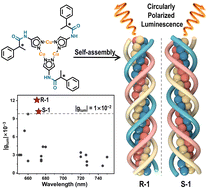
Achieving chirality transfer and amplification through controlled supramolecular aggregation has long been a challenge in chemistry. This study presents the self-assembly of homochiral triple-helical aggregates (P- and M-type) with enantiomerically pure Cu(I) cyclic trinuclear complexes (CTCs) through metallophilic and hydrogen-bonding interactions. Both P- and M-type aggregates exhibit bright orange-red phosphorescence and circularly polarized luminescence (CPL) emission with an exceptional luminescence dissymmetry factor (glum) of approximately ±1 × 10⁻². These values are the highest among coinage metal-based complexes with emissions across the red and near-infrared. Experimental results and computational simulations reveal that the extensive overlap of chiral and luminescent centers is key to enabling CPL activity. Further installing naphthyl chromophore in the pyrazolate ligands results in isostructural triple-helical aggregates with rarely observed dual CPL emission behavior. Overall, this study showcases the successful construction of homochiral triple-helical aggregates by incorporating chiral centers and hydrogen-bonding sites into the peripheral pyrazolate ligands of Cu(I) CTCs, allowing for chirality transfer and amplification, evidenced by large glum values of CPL emission. These findings may facilitate the bottom-up design of homochiral supramolecular aggregates for CPL-related applications.
 Please wait while we load your content...


