


 PLATFORM UPDATE:


Structure–activity relationships can be directly extracted from high-throughput crystallographic evaluation of fragment elaborations in crude reaction mixtures
 †ab
Kate K.
Fieseler,
†cde
Rubén
Sanchez-Garcia,
ce
Warren
Thompson,
bd
Charlotte M.
Deane,
c
Frank
von Delft
bdef
and
Philip C.
Biggin
*a
†ab
Kate K.
Fieseler,
†cde
Rubén
Sanchez-Garcia,
ce
Warren
Thompson,
bd
Charlotte M.
Deane,
c
Frank
von Delft
bdef
and
Philip C.
Biggin
*a
Abstract
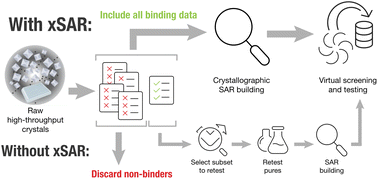
Fragment-based drug design offers multiple routes to advance from fragments. One approach is to build structure–activity relationships (SAR) from analogue series in direct-to-biology workflows. Analogues can be prepared by automated chemistry and tested as crude reaction mixtures (CRMs) without purification, but assay noise often leads to hit resynthesis, potentially discarding false negatives and reducing SAR dataset size. High-throughput (HT) X-ray crystallography has the potential to address these issues by resolving hits directly from 100s–1000s of CRMs. However, no systematic analytics exist for extracting SAR models from HT crystallographic evaluation of CRMs. Here, we demonstrate that crystallographic SAR (xSAR) can be extracted from CRMs evaluated via HT X-ray crystallography. We developed a simple rule-based ligand scoring scheme that identifies conserved chemical features associated with crystallographic binding and non-binding. Applied to a crystallographic dataset of 957 fragment elaborations in CRMs targeting PHIP(2), a therapeutically relevant bromodomain, our xSAR model demonstrated effectiveness in two proof-of-concept experiments. First, it recovered 26 missed binders in the initial dataset (false negatives), doubling the hit rate and denoising the dataset. Second, it enabled a prospective virtual screen that identified novel hits with informative chemistries and measurable binding affinities. This work establishes a proof-of-concept that xSAR models can be directly extracted from large-scale crystallographic readouts of CRMs, offering a valuable methodology to build SAR models and accelerate design-make-test iterations without requiring CRM hit resynthesis and confirmation. This invites future work to utilise advanced analytics and modelling techniques to further strengthen purification-agnostic workflows.
- This article is part of the themed collection: #MyFirstChemSci 2026
 Please wait while we load your content...


