


 PLATFORM UPDATE:

Metal single-atom modified TiO2 or g-C3N4: reaction mechanism and research progress as semiconductor photocatalysts
 *ab
*ab
Abstract
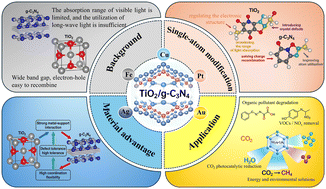
As photocatalytic materials, TiO2 and g-C3N4 are widely used in the degradation of organic pollutants, removal of volatile organic compounds or nitrogen oxides, and photocatalytic reduction of CO2, among other applications, and have excellent prospects for use. However, due to the large band gap of TiO2, its absorption of visible light is limited, and the electron–hole pair is easy to recombine, resulting in poor photocatalytic performance. Although g-C3N4 can absorb visible light, its limited absorption range and insufficient utilization of long-wavelength light also restrict its photocatalytic performance. Single-atom modified TiO2 or g-C3N4 has become a new strategy to overcome these challenges. TiO2 and g-C3N4 are widely used as ideal carriers for single-atom photocatalysts, benefiting from their strong metal–support interactions (SMSIs), high coordination flexibility, excellent chemical stability, defect tolerance, and scalability. Single-atom modified TiO2 or g-C3N4 can precisely tailor the electronic structure, introduce crystalline defects, and optimize light absorption characteristics. They effectively address key limitations in photocatalysis, including rapid charge recombination, a narrow visible light response range, and low atomic utilization efficiency, thereby enhancing overall performance. In this paper, we summarize the research progress on single-atom modified TiO2 or g-C3N4 photocatalysts, including those modified with Cu, Fe, Pt, Ag, and Au, and analyze their excellent photocatalytic performance and possible reaction mechanisms in detail. Finally, a brief perspective has been proposed to improve the photocatalytic activity by single-atom modified TiO2 or g-C3N4 in solving energy and environmental problems.
 Please wait while we load your content...


