


 PLATFORM UPDATE:

Ciprofloxacin degradation in an electro-Fenton system with an S-nZVI@BC/NF composite electrode
 *a
Jingwen
Wu,
a
*a
Jingwen
Wu,
a
Abstract
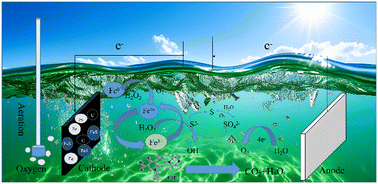
In this study, a biochar-supported sulfurized nano-zero-valent iron modified nickel foam (S-nZVI@BC/NF) composite electrode material was prepared by chemical reduction and hydrothermal methods. And this material was employed as a cathode in an electro-Fenton (EF) system, enabling in situ generation and activation of hydrogen peroxide (H2O2) to achieve efficient removal of antibiotic ciprofloxacin (CIP) from aqueous solutions. Structural and electrochemical properties of the electrode were thoroughly investigated by means of scanning electron microscopy (for morphological characterization), X-ray diffraction (for crystal structure analysis), X-ray photoelectron spectroscopy (for surface chemical composition detection), and electrochemical testing (for activity assessment). Catalytic activities of different electrodes were evaluated via comparative experiments, and the effects of parameters such as the Fe/C ratio, voltage, aeration rate, pH, and Na2SO4 concentration on degradation efficiency were systematically investigated. Results show that the S-nZVI@BC/NF composite electrode exhibits excellent morphology, structure, and electrochemical performance. Specifically, when the initial CIP concentration was 10 mg L−1, the Na2SO4 concentration was 30 mM, the applied voltage was 2.5 V, the initial pH was 3, the reaction time was 120 min, the aeration rate was 1.2 L min−1, and the degradation efficiency reached 99.4%. Additionally, the stability and applicability of the system under varying pollutant concentrations, types, water matrices, and anion conditions were evaluated. The degradation mechanism and pathway were further explored via quenching experiments combined with LC–MS analysis.
 Please wait while we load your content...


