


 PLATFORM UPDATE:

The promotional effect of gallium loading on the bifunctional Cu–Ga/γ-Al2O3 catalyst for CO2 hydrogenation to methanol and dimethyl ether at atmospheric pressure
 *a
*a
Abstract
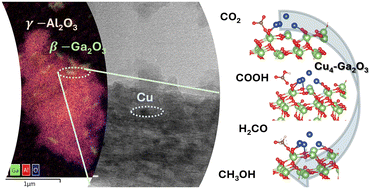
Hydrogenation of CO2 to methanol and dimethyl ether (DME) was investigated over gallium-promoted copper catalysts supported on γ-Al2O3 (Cu–Ga/γ-Al2O3) at atmospheric pressure—conditions under which Ga-promoted Cu/γ-Al2O3 catalysts have not been investigated before. Reaction parameters—including temperature, H2 : CO2 feed ratio, and gas hourly space velocity (GHSV)—were optimized prior to evaluating the effect of Ga loading. Catalysts with varying Ga loadings (5, 10, 12, and 15 wt%) were tested, with the 5 wt% Ga catalyst achieving the highest combined formation rate of methanol and DME at 246 μmolcarbon gcat−1 h−1 and a combined selectivity of 20.6% under optimal conditions (220 °C, 9 : 1 H2 : CO2, GHSV = 30 000 mL gcat−1 h−1), where the DME production rate was twofold that of the Ga-free catalyst. For comparison, a commercial Cu/ZnO/Al2O3 catalyst was synthesized and showed a significantly lower methanol selectivity (7.2%) and formation rate (60 μmol gcat−1 h−1) under identical operating conditions, with no DME production observed. The promotional effect of Ga was further explored using periodic density functional theory (DFT) calculations on a Cu4/β-Ga2O3(001) model. Theoretical results suggest that CO2 hydrogenation proceeds primarily via a carboxyl intermediate, rather than through formate or CO pathways.
 Please wait while we load your content...


