


 PLATFORM UPDATE:


High-throughput experimentation for the application in oxidation reactions: solid dispensing approach for miniaturised reactions

Abstract
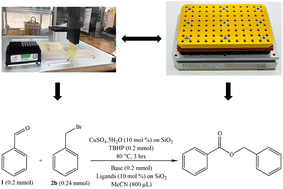
The traditional reaction screening method means testing reagents such as bases, ligands, and catalysts using trial-and-error approaches, which is tedious, and fewer reagents can be evaluated. However, by developing a method that can be used to dispense solid chemical reagents at a nanomole scale for high-throughput reaction screening (HTS), a combination of multiple reagents can be screened rapidly until optimal reagents can be identified. As a proof of principle, a solid dispensing method developed using silica (SiO2) as an inert carrier of reagents was utilised to screen four bases and twelve ligands for the copper-catalysed oxidative esterification of benzaldehyde and the oxidation reaction of styrene. Using high-throughput screening together with the developed solid dispensing method, about 96 reactions of copper-catalysed oxidative esterification of benzaldehyde with ethyl bromide and benzyl bromide were screened, and one reaction of oxidation of styrene until an optimal combination of reagents was found.
- This article is part of the themed collection: Reaction Chemistry & Engineering Open Access Spotlight 2026
 Please wait while we load your content...


