


 PLATFORM UPDATE:

Advances in continuous manufacturing of albuterol sulfate: optimization of an amination reaction in flow

Abstract
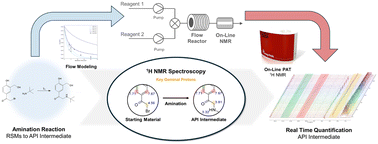
Albuterol sulfate, an asthma therapeutic, has historically been manufactured via batch processing yet is perennially listed on the FDA's drug shortage list. This work investigates the translation of a batch SN2 amination reaction for synthesis of a key albuterol precursor towards continuous flow processing monitored with on-line 1H NMR. The results detailed herein enable integration and scale-up of the unit operation within a larger end-to-end Advanced Manufacturing Technology (AMT) for continuous albuterol sulfate production. Initial batch screening studies were conducted to optimize process variables, determine kinetic parameters, and identify byproducts. Laminar and plug flow models were developed using batch kinetic data to simulate reactant conversion during molecular transit through a tubular reactor; the models were compared with experimental flow data at 20–60 °C. A pseudo first order flow model most accurately modeled the reaction in flow – enabling intelligent reactor design and scale-up by simulating yield at various temperatures (T), flowrates (Q), and residence times (τ). The experimental flow study demonstrated optimal solution yield (99.3 ± 4.6%) and conversion (99.0 ± 0.8%) of the starting material [50 mg ml−1] when the reaction was performed in isopropanol at 60 °C with a 40 min τ. 1H NMR was utilized as an on-line process analytical technology (PAT); key reaction species were identified and calibrated to enable quantification of concentration via an integrated flow cell. Ultimately, this work offers a continuous method of synthesizing a key API intermediate with on-line composition monitoring for integration and scale-up within a larger end-to-end AMT system to help alleviate drug shortages.
- This article is part of the themed collection: Reaction Chemistry & Engineering Open Access Spotlight 2026
 Please wait while we load your content...


