


 PLATFORM UPDATE:


A rapidly assembled ZnS–AB electrochemical sensor with enhanced performance for luteolin determination
 *a
and
Haijun
Pang
b
*a
and
Haijun
Pang
b
Abstract
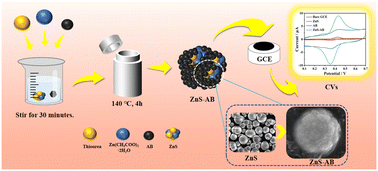
Luteolin (LU) exhibits notable antimicrobial, anti-inflammatory, and antioxidant activities by inhibiting inflammatory mediators and protecting cells from oxidative stress-induced damage. However, excessive LU intake may cause adverse health effects. In this work, a novel composite material, ZnS–AB, composed of zinc sulfide (ZnS) and acetylene black (AB), was successfully synthesized and applied for the efficient electrochemical detection of LU. The incorporation of AB effectively enhanced the conductivity of ZnS and promoted charge transfer, thereby improving the sensing performance of the ZnS–AB electrode. The sensor displayed a wide linear range of 0.0010–0.21, 0.21–3.7, and 3.7–28 μM with an ultralow detection limit of 0.0003 μM. It also exhibited excellent selectivity against common interfering species. Furthermore, the sensor was successfully applied to the determination of LU in Lonicera japonica and rat serum samples with satisfactory recovery rates, demonstrating low cost and strong potential for on-site rapid detection.
 Please wait while we load your content...


