


 PLATFORM UPDATE:

Deciphering alcohol dehydrogenase catalysis in glycerol-based deep eutectic solvents through experimental and computational insights

Abstract
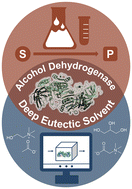
Designing enzyme-compatible deep eutectic solvents (DESs) may be challenging due to their compositional complexity and variable enzyme responses. For instance, glycerol is beneficial for enzyme catalysis, while choline chloride is detrimental. This study assesses, experimentally and computationally, the performance of horse liver alcohol dehydrogenase (HLADH) in two glycerol-based DESs: betaine–glycerol (Bet–Gly, choline–chloride-free) and choline acetate–glycerol (ChAc–Gly, only chloride-free). Bet–Gly enables superior HLADH stability and activity, while ChAc–Gly, despite improved thermostability, shows significantly lower activity. Molecular dynamics (MD) simulations revealed a critical solvation transition at ∼20 vol% water content, where water begins to dominate the enzyme's solvation shell, maximizing enzyme stability at 40–50 vol%. Hydrogen-bond analyses reveal that water preferentially fills internal cavities at low concentrations, while in excess, it disrupts the stabilizing glycerol shell. Free energy profiles, calculated with MD, demonstrate that Bet–Gly permits unimpeded substrate diffusion and optimal positioning near the catalytic zinc ion. In contrast, ChAc–Gly components infiltrate the active site, increasing energy barriers and impeding catalysis. These findings highlight the dual role of DES composition and hydration in modulating enzyme stability and function, offering design principles for future tailored biocatalytic environments in non-aqueous media.
 Please wait while we load your content...


