


 PLATFORM UPDATE:


Oxygen-vacancy-engineered BiO2−x/Bi2O3 heterojunctions for synergistic photo-tribocatalytic degradation and broad-spectrum antibacterial performance
 *a
Wei
Zhao
a
and
*a
Wei
Zhao
a
and
Abstract
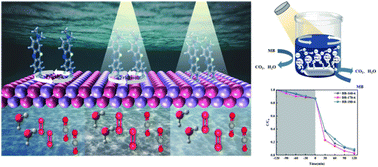
Limitations of photocatalytic technology, such as a high recombination rate of photogenerated carriers and limited spectral response range, restrict the degradation capability of photocatalytic materials, hindering the practical application. In this paper, BiO2−x/Bi2O3 heterojunctions are successfully constructed by precisely controlling hydrothermal time and temperature, and the synergistic enhancement catalytic mechanism, involving oxygen vacancy regulation, heterojunction design, and the coupling of photo- and tribo-energy, is systematically revealed. The sample synthesized at 170 °C for 6 h possesses the highest oxygen vacancy concentration, a reasonable Bi3+/Bi5+ ratio and a narrow band structure. Under photo-tribocatalysis, the optimized sample achieves 99% degradation of methylene blue within 2 h, maintaining a degradation efficiency retention rate of 94% after three consecutive cycles. Furthermore, the sample exhibits excellent broad-spectrum antibacterial performance, achieving bactericidal rates exceeding 90% against Bacillus pasteurii, Saccharomyces cerevisiae and Bacillus mucilaginosus. Additionally, density functional theory calculations that the mechanical stress induced by friction can optimize the migration rate and pathways of carriers at the heterogeneous interface, thereby enhancing the catalytic degradation activity. Therefore, this work comprehensively provides both theoretical foundations and experimental support for the development of new high-efficiency catalytic degradation materials.
 Please wait while we load your content...


