


 PLATFORM UPDATE:


Data-driven design of TiO2–zeolite photocatalysts for sustainable vanillin production

Abstract
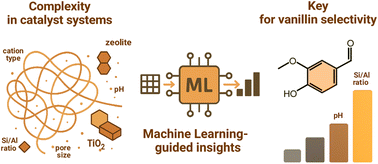
We integrate machine learning (ML) with TiO2–zeolite photocatalysis to convert biomass-derived 4-vinylguaiacol (4-VG) to vanillin via partial oxidation, thereby elucidating the dominant descriptor governing vanillin selectivity. Exploratory screening of a set of 16 zeolites and 12 TiO2 photocatalysts revealed that composite systems enhance vanillin selectivity up to 36%, compared with 15% for TiO2 alone. ML models such as random forest (RF), trained on 20 zeolite datasets (16 training and 4 test samples) incorporating six physicochemical descriptors, identified the Si/Al ratio of zeolite as the dominant descriptor. Validation experiments guided by ML predictions attributed its effect to pH buffering at the TiO2 liquid interface, sustaining an alkaline microenvironment and stabilizing selectivity against pH drift. The synergy between ML analysis and ML-guided validation experiments proved effective even when applied to chemically curated datasets of limited size, providing transferable design principles for composite photocatalysts.
 Please wait while we load your content...


