


 PLATFORM UPDATE:


Enhancing the catalytic activity of ZnO nanocatalysts reinforced with boron compounds in promoting green and sustainable fixation of CO2 with epoxides
 *b
*b
Abstract
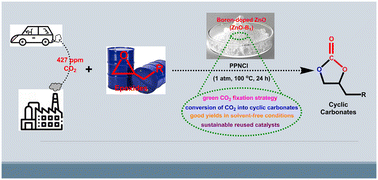
The preparation of efficient and eco-friendly catalysts for the cycloaddition of CO2 and epoxides has been extensively researched for a long time with the aim of achieving green chemistry and net zero emissions. Herein, we report commercial and synthesized boron-doped ZnO nanocatalysts for the formation of target cyclic carbonates by enhancing the efficiency of cyclization reactions of CO2 and various epoxides through a strong synergistic effect between the metal active site and Lewis acidic boron molecules. FT-IR spectroscopy, UV-vis spectroscopy, TGA-DTA, ICP-OES, XRD, SEM, and EDX-mapping techniques were utilized for structural characterization of ZnO and ZnO-B(1–3) nanocatalysts. The optimized ZnO and ZnO-B(1–3) nanocatalysts efficiently carried out the coupling reaction of CO2 and epoxides to form organic cyclic carbonates under ambient pressure, without the need for solvent, and as an alternative to the toxic and expensive phosgene gas. Among these prepared catalysts, the ZnO-B1/PPNCl binary catalytic system was found to be the most active catalyst for the effective transformation of CO2 into value-added cyclic carbonates, yielding 99% with ≥99% selectivity under ambient pressure at 100 °C for 24 h using epichlorohydrin (ECH). According to the catalytic results obtained, the electronic properties and defect dynamics of the ZnO structure and the synergistic effect due to the Lewis acidic properties of boron compounds significantly improved the catalytic performance during the conversion of CO2 to cyclic carbonates. Moreover, the ZnO-B1/PPNCl binary catalytic system demonstrated exceptional recyclability, exhibiting no decline in catalytic activity over five consecutive reaction cycles. The kinetic studies show the rate constant of the catalytic CO2 cycloaddition reaction, and the kinetics of this coupling reaction were estimated to be pseudo-first-order, and the rate constant was 0.0875 h−1 at 100 °C under similar reaction conditions.
 Please wait while we load your content...


