



Himalayan forest waste to carbon nanotubes: a green approach using NADES template for reactive orange 16 dye adsorption

Abstract
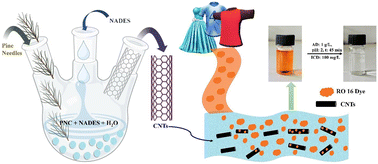
The development of environmentally benign methods for synthesizing carbon nanomaterials from biomass is gaining momentum due to growing concerns about sustainability and industrial pollution. In this study, Pinus roxburghii biomass was utilized as a renewable precursor for the hydrothermal synthesis of functionalized carbon nanotubes (f-CNTs). Natural deep eutectic solvents (NADESs), formulated using various hydrogen bond donors (HBDs) and choline chloride (ChCl) as a hydrogen bond acceptor (HBA), were explored as green, structure-directing, and functionalizing agents. Among the tested combinations, [ChCl/oxalic acid] (1 : 1 molar ratio) proved most effective in directing the formation of well-defined tubular nanostructures under optimized conditions (120 °C, 5 h). The synthesized f-CNTs were subsequently applied for the adsorption of reactive orange 16 (RO16), a persistent azo dye commonly found in industrial effluents from textile-dense regions. Adsorption performance was evaluated through studying the adsorption isotherms and kinetic models, revealing that the process followed chemisorption. The thermodynamic analysis of the process was also conducted, depicting the endothermic (ΔH = 6783.47 J mol−1) and spontaneous nature of the process. The synthesized f-CNTs offered a maximum adsorption capacity of 111.11 mg g−1. Thus, this study illustrates the green route for the synthesis of CNTs using NADESs while meeting the sustainable development goals and also curbing the water pollution caused by reactive dyes.
 Please wait while we load your content...


