


 PLATFORM UPDATE:


ANN-based prediction of equilibrium gas composition and carbon yield in methane pyrolysis and reforming methods

Abstract
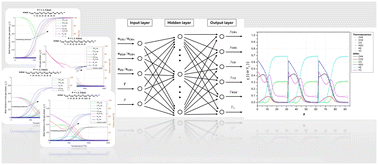
We investigate the potential of artificial neural networks (ANNs) to approximate the equilibrium gas-phase composition and carbon yield in methane pyrolysis (MP), dry reforming of methane (DRM), steam methane reforming (SMR), and partial oxidation of methane (POM). Unlike the conventional thermodynamic approach, which relies on the Gibbs free energy minimization, the ANN-based method provides a data-driven alternative. Using supervised learning, the model captures the complex, nonlinear relationships between process parameters, such as temperature, pressure, and reactant ratios, and the resulting equilibrium product compositions. This approach not only circumvents the computationally intensive nature of Gibbs energy minimization but also enables rapid predictions across a broad range of operating conditions. The study evaluates the performance of a representative ANN architecture and compares its predictions with conventional thermodynamic calculations to assess the method's accuracy and generalization capability. The results demonstrate that the trained ANN predicts the gas-phase compositions and carbon yields very well, even when all input variables are interpolated. Moreover, the ANN performs the same task several thousand times faster than the conventional method. Overall, the results demonstrate the potential of ANNs as efficient tools for accelerating equilibrium calculations in methane conversion processes. The developed and validated approach can be considered a useful tool for predicting the equilibrium gas composition and carbon yield in methane pyrolysis and reforming processes. The SI provides the synaptic weights necessary for the practical application of ANNs to calculate the equilibrium gas composition and carbon yield in MP, DRM, SMR, and POM over a wide range of temperatures, pressures, and initial reactant compositions.
- This article is part of the themed collections: Hydrogen Production and Reaction Chemistry & Engineering Open Access Spotlight 2025
 Please wait while we load your content...


