


 PLATFORM UPDATE:


Recovery of lithium from spent lithium-ion batteries using carbothermal reduction with spent coffee grounds: a parametric optimization using a combined approach of response surface methodology and machine learning
 a
Hemant
Goyal
a
and
a
Hemant
Goyal
a
and
Abstract
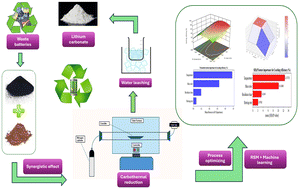
The world today faces the challenge of recovering valuable metals from spent lithium-ion batteries, as improper disposal of battery waste presents significant environmental risks. With the growing demand for lithium resources, the extraction of lithium from waste batteries has become increasingly crucial for resource sustainability and environmental protection. In response to this challenge, this study introduces spent coffee grounds as a novel biomass material for selective lithium extraction through carbothermal reduction with spent cathode powder. During the carbothermal reduction process, lithium in the spent cathode powder is converted into Li2CO3, while transition metals such as nickel (Ni), cobalt (Co) and manganese (Mn) are reduced to a lower oxidation state. In this process, the biomass undergoes thermal treatment in an inert atmosphere to generate CH4, H2, and CO gases, along with biochar. Biochar and the gaseous products act as effective reducing agents for the metal oxides present in the spent cathode powder. The high fixed carbon content and reactive surface of biochar facilitate solid–solid reduction, while the generated gases such as CO and H2 serve as strong gaseous reducing agents. The reduction residue obtained after carbothermal reduction contains lithium predominantly as lithium carbonate. This lithium carbonate can be efficiently leached using water and subsequently recovered through evaporative crystallization. The effect of parameters such as temperature, the mass ratio of spent coffee grounds to spent cathode powder (BCMR), residence time, and heating rate on leaching efficiency, along with process modeling and optimization, was also investigated using a combined approach of response surface methodology (RSM) and machine learning (ML). The optimized leaching efficiency was observed with the RSM model to be 81.3% and the decision tree model of machine learning to be 80.16% under optimized conditions of a temperature of 587 °C, a BCMR of 0.97, a residence time of 19.4 minutes, and a heating rate of 5.8 °C min−1. The spent coffee grounds, spent cathode powder, reduction residue, and leaching residue were analysed using TGA, SEM-EDX, XRD, and XPS techniques. This approach offers an improved strategy for the valorization of spent coffee grounds in carbothermal reduction, facilitating the selective recovery of lithium from spent lithium-ion batteries, with significant potential for various industrial applications.
 Please wait while we load your content...


