


 PLATFORM UPDATE:


Synthesis, photophysical, computational, and cytotoxicity evaluation of carborane-appended phenylene and triazine trimers: elucidating the role of the central core

Abstract
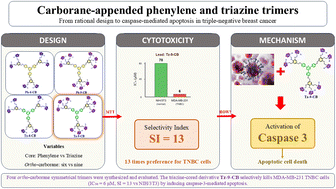
The development of tumor-selective boron carriers is critical for advancing targeted cancer therapies. In this study, we report the design, synthesis, and characterization of four ortho-carborane-appended symmetrical trimers, Ph-6-CB, Ph-9-CB, Tz-6-CB, and Tz-9-CB, to systematically compare the influence of central-core electronics and peripheral carborane density on photophysical and biological properties. Photophysical studies revealed that all four conjugates exhibit strong π–π* absorption in the 328–335 nm region; the triazine-cored derivatives show a modest blue shift relative to their phenylene analogs. Phenylene derivatives retain higher fluorescence quantum yields than their triazine analogs. Qualitative DFT analysis displays smaller HOMO–LUMO separations and substantially higher computed electrophilicity indices for triazine analogs than the phenylene analogs. Preliminary in vitro cytotoxicity assays against MDA-MB-231 triple-negative breast cancer cells and NIH/3T3 mouse embryo fibroblasts revealed higher potency and greater cancer selectivity of triazine derivatives than their phenylene counterparts. Tz-9-CB emerged as the lead candidate, with an IC50 of 6 µM against MDA-MB-231 cells and a selectivity index of 13 relative to NIH/3T3 fibroblasts. Mechanistic studies, including Live/Dead fluorescence imaging and caspase-3 activation assays, confirmed that Tz-9-CB induces cell death primarily through apoptosis. These findings highlight the potential of triazine-cored, carborane-rich dendrimers as selective scaffolds for boron-based cancer therapeutics.
 Please wait while we load your content...


