


 PLATFORM UPDATE:


Hierarchical pore engineering in waste-derived carbons for supercapacitors: bridging the performance gap from three-electrode evaluation to practical two-electrode devices

Abstract
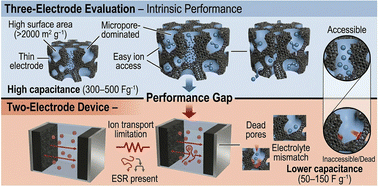
Supercapacitors based on waste-derived porous carbons have attracted significant attention due to their low cost, sustainability, and tunable pore structures. However, a persistent discrepancy remains between the high capacitance values reported in three-electrode (half-cell) configurations and the significantly lower performance observed in practical two-electrode devices. This gap is frequently overlooked, leading to overestimation of material performance and limiting the translation of laboratory-scale results into real applications. This review critically examines recent advances in hierarchical pore engineering of waste-derived carbons with a specific focus on understanding and bridging the performance gap between intrinsic material properties and device-level behaviour. We first analyse the fundamental differences between three-electrode and two-electrode evaluation systems, highlighting the origins of performance inflation that arise from low mass loading, restricted voltage windows, electrolyte effects, and the neglect of internal resistance. A quantitative and mechanistic framework is then established to explain the translation of capacitance from single-electrode to full-cell configurations. Building on this, structure–performance relationships are systematically evaluated across multiple studies to identify why materials with ultrahigh surface areas (>2000 m2 g−1) often fail to deliver superior device performance. Particular attention is given to the roles of pore accessibility, ion transport limitations, electrolyte-pore matching, and the trade-off between porosity and electrical conductivity. The effectiveness of hierarchical pore architectures and heteroatom doping is critically reassessed, distinguishing genuine performance enhancements from overstated effects. Finally, design principles for developing device-relevant carbon electrodes are proposed, emphasising accessible porosity, optimised pore connectivity, and realistic testing conditions. Practical challenges related to scalability, reproducibility, and environmental impact are also discussed. This review provides a comprehensive framework for transitioning from inflated laboratory metrics to reliable, high-performance supercapacitor devices based on waste-derived carbons.
 Please wait while we load your content...


