


 PLATFORM UPDATE:


Clean hydrogen from water: emerging technologies for a sustainable energy future

Abstract
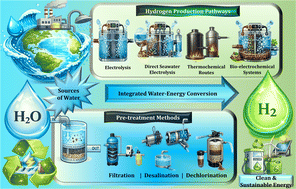
Hydrogen has become more and more accepted as a key component in the transition to cleaner energy systems since it provides a high energy output without producing carbon on site. Although this is a potential, the majority of hydrogen is produced through fossil-based processes. Low-carbon hydrogen production pathways such as water electrolysis are increasingly attracting attention; however, their large-scale deployment is influenced primarily by electricity demand, system efficiency, and water quality requirements rather than bulk water consumption itself. Even more clean production paths like electrolysis are usually reliant on high-quality freshwater, particularly in proton exchange membrane (PEM) systems where high-purity feedwater is necessary to prevent membrane degradation and catalyst poisoning. Although the actual water consumption associated with electrolysis is relatively modest compared with many industrial processes, there is a shift in focus to use of alternative water sources to improve resource circularity and reduce dependence on high-purity freshwater in water-stressed regions. The concept of all water to hydrogen is to combine water treatment with hydrogen production enabling the use of various forms of water as a clean energy feedstock. This will not only alleviate pressure on freshwater resources, but also encourage the use of wastewater in a circular economy structure. In this aspect, freshwater, seawater, wastewater, and grey water are all under consideration as means of producing hydrogen. This review examines the connection between water and hydrogen generation, highlighting the necessity to shift towards systems that are not based on freshwater and focus on less utilized and more accessible water resources. The review further emphasizes that the dominant techno-economic challenge in electrolysis remains the high energy requirement associated with water splitting, while water quality mainly affects electrolyser durability and long-term operational stability. There is an indication that given the right pre-treatment techniques, long-lasting materials to stop corrosion, and enhanced electrochemical technologies, various water sources can be utilized successfully to generate hydrogen. Production of hydrogen using saline and wastewaters is also a viable path forward in solving the energy and water crises at the same time. This article unites the latest advancement and technology that contribute to the idea of All Water to Hydrogen. Its unique contribution is its analysis of various water sources in one framework in particular, the wastewater systems, their treatment requirements, performance efficiency, and scaling-up factors. The review offers a clear way to apply this concept to the real-world applications by linking hydrogen production and sustainable water management.
 Please wait while we load your content...


