


 PLATFORM UPDATE:


Cryogenic magnetocaloric effect in a disordered double-perovskite Gd2MnZnO6

Abstract
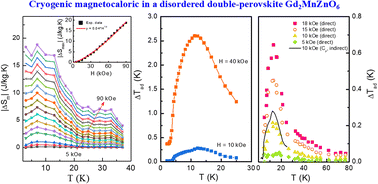
This work presents an investigation on the structural characterization, magnetic behavior, and cryogenic magnetocaloric (MC) effect of a disordered double-perovskite Gd2MnZnO6 prepared via a solid-state reaction method. Powder X-ray diffraction analysis reflects that the title compound crystallizes in an orthorhombic structure with the Pnma space group. Its MC performance has been systematically assessed by means of the magnetic entropy change (|ΔSm|), adiabatic temperature change (ΔTad) and heat capacity Cp. As a result, under an applied field of 40 kOe, the directly measured ΔTad reaches approximately 2.6 K. Meanwhile, the largest |ΔSm| and relative-cooling power values (RCP) are about 19 J kg−1 K−1 and 331 J kg−1, respectively, for a magnetic-field change of 90 kOe. Such large values of the parameters characteristic for the MC effect make Gd2MnZnO6 a promising candidate for cryogenic magnetic refrigeration. Furthermore, analysis of the M(T, H) and |ΔSm(T)| data around the magnetic-phase transition indicates the presence of short-range magnetic order. This behavior is attributed to the coexistence of competing ferromagnetic and antiferromagnetic interactions in Gd2MnZnO6.
 Please wait while we load your content...


