


 PLATFORM UPDATE:


Efficient removal of mercury(ii) ions using glutamic acid modified metal–organic frameworks: adsorption models, thermodynamics, and parameter optimization

Abstract
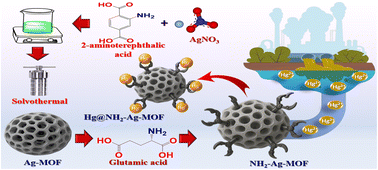
The targeted removal of mercury(II) ions from contaminated aqueous systems presents a significant environmental issue, attributed to mercury's high toxicity, persistence in nature, and potential for bioaccumulation. This research focuses on the synthesis and assessment of a glutamic acid-functionalized silver metal–organic framework (NH2-Ag-MOF) as an effective sorbent for the elimination of Hg(II) ions from water. The modified framework demonstrated remarkable properties, including a substantial surface area of 1750.49 m2 g−1, a mesoporous structure with an average pore diameter of 3.84 nm, and a plethora of nitrogen-rich functional groups that markedly improved its affinity for mercury. Characterization techniques such as XRD, FT-IR, SEM, EDX, BET analysis, and XPS verified the successful functionalization of amine groups while preserving the structural integrity of the parent Ag-MOF. Batch adsorption experiments revealed that the uptake of Hg(II) was significantly affected by parameters including pH, dosage, temperature, and initial concentration, with a maximum adsorption capacity of 638.2 mg g−1 attained. The adsorption behavior was consistent with the Langmuir isotherm model and followed pseudo-second-order kinetics, indicative of monolayer chemisorption, supported by an adsorption energy value of 31.6 kJ mol−1. Thermodynamic analysis showed a positive enthalpy change (ΔH° = 84.9 kJ mol−1) and negative changes in Gibbs free energy (ΔG°), confirming that the adsorption process is endothermic and proceeds spontaneously. Furthermore, Density Functional Theory (DFT) calculations indicated that the binding of Hg(II) is facilitated through C![[double bond, length as m-dash]](https://www.rsc.org/images/entities/char_e001.gif) O coordination and electrostatic interactions with –COO− groups present. The adsorbent exhibited efficiency across five regeneration cycles.
O coordination and electrostatic interactions with –COO− groups present. The adsorbent exhibited efficiency across five regeneration cycles.
 Please wait while we load your content...


