


 PLATFORM UPDATE:


Chemical interaction-driven sensitivity enhancement in graphene-integrated photonic crystal biosensors for hormone detection
 *b
*b
Abstract
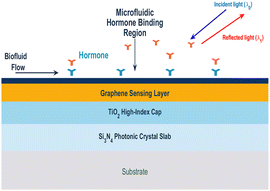
We report the development of a chemically enhanced photonic crystal-based biosensing platform enabling highly sensitive and label-free detection of critical female reproductive hormones, specifically estradiol (E2), progesterone (P4), and luteinizing hormone (LH). The proposed platform integrates a Si3N4/TiO2 photonic crystal slab with a graphene-functionalized interface, where π–π interactions and surface adsorption mechanisms significantly enhance molecular binding efficiency. The sensing mechanism is governed by chemically induced refractive index perturbations at the graphene interface, which are optically converted into measurable resonance shifts. Detailed evaluation of the device's structural and optical parameters indicates that the combined effect of strengthened electromagnetic field confinement and chemically driven adsorption mechanisms results in notable improvements in both sensitivity and spectral resolution. The sensor exhibits a concentration-dependent redshift with sub-ng mL−1 detection capability within physiologically relevant ranges. Furthermore, the thermal response remains minimal compared to analyte-induced variations, thereby confirming the chemical selectivity of the sensing process. The proposed platform establishes a synergistic opto-chemical sensing framework with strong potential for real-time, label-free biosensing in biomedical diagnostics.
 Please wait while we load your content...


