


 PLATFORM UPDATE:


Development of a green and sustainable rice husk nanosilica-based spectrophotometric probe for dual detection of Ag(i) and Fe(iii) in environmental and E-waste matrices
 *c
Thamer S.
Alraddadi,
c
Biprajit
Sarkar,
d
Reda F. M.
Elshaarawy,
*e
Ahmed
Shahat
c
and
Mohamed
Shenashen
f
*c
Thamer S.
Alraddadi,
c
Biprajit
Sarkar,
d
Reda F. M.
Elshaarawy,
*e
Ahmed
Shahat
c
and
Mohamed
Shenashen
f
Abstract
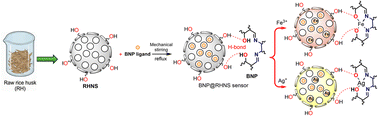
The development of sustainable, economical sensing platforms for rapid monitoring of toxic metals is a critical priority for environmental safety. In this work, a new dual-functional BNP@RHNS nanocomposite sensor was fabricated by immobilizing Br-naphthophen ligand onto agrowaste (rice husk)-derived mesoporous nanosilica. The sensor surface maintains the amorphous nanosilica framework and successfully anchors ligands covalently or non-covalently, according to the physicochemical characterization methods used. The sensor exhibited remarkable spectrophotometric selectivity toward Ag+ and Fe3+ ions in aqueous environments with an optimized response time <40 s. The method also showed broad linear dynamic ranges of 0–0.8 ppm and 0–0.85 ppm, and low limits of detection (LOD) of 0.185 ppm and 0.247 ppm for Ag+ and Fe3+ ions under the optimized conditions (pH 6.2 & pH 3.6 at 25 °C). The sensing mechanism was meticulously detailed through experimental spectral shifts and corroborated by Density Functional Theory (DFT) calculations. The theoretical work showed that the recognition process is governed by the spontaneous formation of stable coordinate complexes located in the ligand's N2O2 cavity. Moreover, the sensor exhibited high interfering tolerance and was successfully applied to determining metal ions in real water matrices with satisfactory recovery rates (97.37% to 100.73%). Furthermore, this sensor was found to be effective in recovering Ag(I) from leachates of electronic waste, suggesting its broader applicability in urban mining and resource recovery. These findings suggest a promising alternative valorization strategy for rice husk biomass into high-value functional materials for advanced environmental monitoring applications.
 Please wait while we load your content...


