Issue 28, 2026, Issue in Progress

Derivatization-assisted dual-mode colorimetric and fluorometric detection of dopamine using 4-hexyl resorcinol

Abstract

The quantification of dopamine (DA) is of great significance because abnormal DA levels are closely linked to several neurological and psychiatric disorders, such as Parkinson's disease, schizophrenia, and depression. In addition, DA analysis plays an important role in clinical diagnosis, pharmaceutical quality assessment, and the investigation of biochemical events in complex biological systems. In this work, a derivatization-based dual-mode sensing strategy was developed for DA determination based on its induced oxidative coupling reaction with 4-hexyl resorcinol (4-HRS) under alkaline conditions. This reaction produces azamonardine, a highly emissive compound that exhibits a strong absorption band at 445 nm and intense fluorescence emission at 490 nm under excitation at 450 nm. The proposed method provided linear responses over the ranges of 0.05–520 µM for colorimetric detection and 10–600 nM for fluorescence detection, with detection limits of 0.018 µM and 3.0 nM, respectively. In addition, the method showed strong sensitivity, acceptable selectivity, mild experimental conditions, and reduced analytical expense. When applied to injection and human serum samples, it produced results consistent with those obtained by LC-MS. Recovery values ranged from 95.0% to 107.2%, and all relative standard deviation (RSD) values were below 3.89%, confirming the method's good accuracy and repeatability.
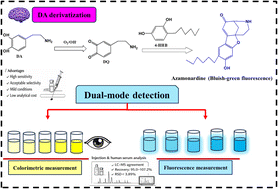
Graphical abstract: Derivatization-assisted dual-mode colorimetric and fluorometric detection of dopamine using 4-hexyl resorcinol

Supplementary files

Transparent peer review

To support increased transparency, we offer authors the option to publish the peer review history alongside their article.

View this article’s peer review history

Article information

Article type
Paper
Submitted
18 Mar 2026
Accepted
08 May 2026
First published
15 May 2026
This article is Open Access
Creative Commons BY-NC license

RSC Adv., 2026,16, 25902-25911

Derivatization-assisted dual-mode colorimetric and fluorometric detection of dopamine using 4-hexyl resorcinol

M. N. Goda, L. S. Alqarni, F. K. Algethami, H. Ibrahim, A. B. H. Ali, R. Ali and M. M. El-Wekil, RSC Adv., 2026, 16, 25902 DOI: 10.1039/D6RA02276F

This article is licensed under a Creative Commons Attribution-NonCommercial 3.0 Unported Licence. You can use material from this article in other publications, without requesting further permission from the RSC, provided that the correct acknowledgement is given and it is not used for commercial purposes.

To request permission to reproduce material from this article in a commercial publication, please go to the Copyright Clearance Center request page.

If you are an author contributing to an RSC publication, you do not need to request permission provided correct acknowledgement is given.

If you are the author of this article, you do not need to request permission to reproduce figures and diagrams provided correct acknowledgement is given. If you want to reproduce the whole article in a third-party commercial publication (excluding your thesis/dissertation for which permission is not required) please go to the Copyright Clearance Center request page.

Read more about how to correctly acknowledge RSC content.

Social activity

Spotlight

Advertisements