


 PLATFORM UPDATE:


Controlled colloidal synthesis and structure–property–stability relationships in lead-free CsMBr3 (M = Mn, Fe, Ni) perovskite nanocrystals
 *a
*a
Abstract
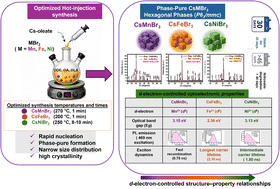
Transition-metal halide perovskites of the form CsMBr3 (M = Mn, Fe, Ni) are emerging as attractive lead-free alternatives for optoelectronic applications, offering composition-tunable electronic structures, strong light–matter interactions, and enhanced environmental stability compared with hybrid lead halide perovskites. Despite this promise, the reliable synthesis of phase-pure, highly crystalline CsMBr3 nanocrystals (NCs) remains challenging due to their pronounced sensitivity to reaction temperature, precursor reactivity, and surface-ligand chemistry. Here, we report a reproducible and optimized colloidal hot-injection strategy for the synthesis of CsMnBr3, CsFeBr3, and CsNiBr3 NCs, and systematically elucidate the influence of reaction temperature and growth time on their structural, morphological, and optical properties. X-ray diffraction confirms the formation of phase-pure hexagonal CsMBr3 (P63/mmc) across all compositions under optimized conditions. Transmission electron microscopy reveals uniform nanocrystal morphologies with narrow size distributions and well-resolved lattice fringes, indicative of high crystallinity. Optical studies, including UV-vis absorption, steady-state photoluminescence, and time-resolved photoluminescence, demonstrate composition-dependent absorption characteristics and exciton recombination dynamics, reflecting the role of the transition metal cation in tuning optoelectronic behaviour. Time-dependent UV-vis and XRD analyses further reveal notable ambient stability over one month, with structural and optical degradation becoming evident only after prolonged exposure beyond 46 days, demonstrating stability far superior to that of equivalent untreated or unencapsulated CsPbBr3 perovskite NCs. X-ray photoelectron spectroscopy confirms correct metal incorporation and stable metal-halide bonding environments, while thermogravimetric analysis uncovers distinct, composition-dependent thermal decomposition pathways. Collectively, this work establishes a clear structure–property–stability relationship for CsMBr3 nanocrystals and provides a robust synthetic framework for advancing next-generation, lead-free perovskite nanomaterials for optoelectronic applications.
 Please wait while we load your content...


