


 PLATFORM UPDATE:


Towards hybrid MOF@COF and COF@MOF platforms for next-generation biocatalysis

Abstract
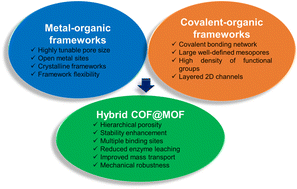
Enzyme immobilization is central to advancing sustainable biocatalysis, yet conventional supports often fail to simultaneously provide structural protection, mass transport, and chemical tunability. Traditional support materials often lack the optimal combination of porosity, stability, and surface functionality needed to preserve enzyme activity. Metal–organic frameworks (MOFs) and covalent organic frameworks (COFs) have emerged as promising hosts due to their high surface area, tunable porosity, and chemical versatility. Recent developments in hybrid architectures MOF@COF and COF@MOF offer a synergistic platform that integrates the structural flexibility and catalytic tunability of MOFs with the robustness and stability of COFs. This review highlights the design principles, immobilization strategies, and catalytic behavior of enzyme@MOF@COF and enzyme@COF@MOF systems. We discuss advances in situ encapsulation, covalent binding, and adsorption-based immobilization, emphasizing how hybrid frameworks enhance enzyme protection, substrate diffusion, and cascade catalysis. Key challenges including scalability, enzyme leaching, and synthesis reproducibility are also critically examined. Finally, we outline future opportunities for rational design of hybrid frameworks that enable precise enzyme spatial organization and multi-enzyme systems, paving the way for next-generation, sustainable biocatalytic technologies.
 Please wait while we load your content...


