


 PLATFORM UPDATE:


Synergetic design of a sulfonated polyimide matrix anchored with phosphotungstic acid-loaded MOFs for enhanced fuel cell efficiency

Abstract
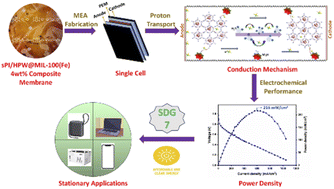
The H2–O2 fuel cell performance of the synthesised sulfonated polyimide (sPI) membrane is significantly enhanced by incorporating a phosphotungstic acid-loaded MOF matrix into the polymer. The sPI polymer is synthesized using a chemical imidization method from its monomers. Herein, we prepare immobilized phosphotungstic acid on the metal organic frameworks of iron (HPW@MIL-100(Fe)) via a hydrothermal process. Composite membranes with varying filler loadings are fabricated using a solution-casting technique. The polymer sPI/HPW@MIL-100(Fe) composites exhibit enhanced physicochemical and electrochemical properties, surpassing those of the pristine sPI membrane. The electrostatic interactions between the polymer functionalities and the filler units are responsible for their performance in fuel cell applications. The membrane loaded with 4 wt% HPW@MIL-100(Fe) exhibits a high water uptake and ion exchange capacity of 21.86% and 1.92 meq per g, respectively. The proton conductivity reached 0.085 S cm−1 for this composite, but the performance declined beyond this loading due to aggregation. The fabricated MEA with 4 wt% HPW@MIL-100(Fe) delivers a power density of 216 mW cm−2 during fuel cell testing. The resultant power output from the sPI/HPW@MIL-100(Fe) electrolyte membrane can be used for stationary applications operating within 150–220 mW cm−2 power density range.
 Please wait while we load your content...


