


 PLATFORM UPDATE:


Beyond conventional lithium-ion: anode-free lithium metal batteries for ultra-high energy and greener storage solutions

Abstract
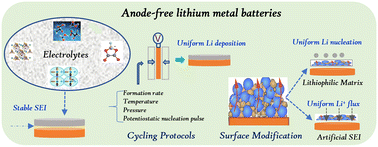
Lithium metal batteries (LMBs) are widely recognized as promising next-generation energy storage systems for electric vehicles and portable electronics owing to their exceptionally high theoretical energy density and specific capacity. However, their practical implementation is fundamentally constrained by severe interfacial and morphological instabilities, including lithium dendrite growth, dead lithium formation, continuous parasitic side reactions, and low Coulombic efficiency during cycling. These coupled degradation processes lead to rapid capacity fading and significant safety concerns. Anode-free lithium metal batteries (AFLMBs), which rely on in situ lithium plating onto a bare current collector and eliminate excess lithium metal, have emerged as an attractive configuration to maximize cell-level energy density while reducing material cost and simplifying fabrication. Nevertheless, the absence of a lithium reservoir renders AFLMBs highly sensitive to irreversible lithium loss. Limited cycle life and rapid capacity decay primarily originate from unstable solid electrolyte interphase (SEI) formation, current collector surface heterogeneity, and uncontrolled lithium nucleation and growth during repeated plating/stripping processes. This review systematically summarizes the fundamental working principles of AFLMBs and critically examines the key scientific and technical challenges limiting their practical application. Particular emphasis is placed on mechanistic insights into lithium deposition and stripping behavior, dendrite initiation and propagation, and dead lithium accumulation from the perspectives of electrochemical kinetics, ion transport, interfacial chemistry, and mechanical stability. Strategies to enhance AFLMB performance including electrolyte engineering, surface modification and structural design of current collectors, and optimization of cycling protocols—are comprehensively discussed. Their effects on interfacial stability, Coulombic efficiency, lithium utilization, and overall electrochemical performance are critically evaluated. Finally, future perspectives and research directions are proposed, highlighting the necessity of advanced characterization techniques, quantitative evaluation metrics, and validation under practical operating conditions. Through rational material design and interfacial engineering, AFLMBs hold substantial promise for enabling safer, high-energy-density, and commercially viable next-generation energy storage technologies.
 Please wait while we load your content...


