


 PLATFORM UPDATE:


Photocatalytic CO2 reduction to methanol: from mechanistic insights to reactor design integration
 a
a
Abstract
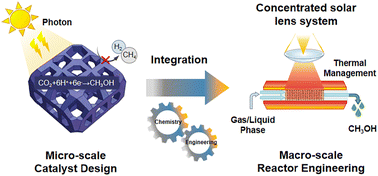
The conversion of CO2 into high-value fuels, particularly methanol, represents a promising pathway for closing the carbon cycle and storing intermittent solar energy. While significant progress has been made in photocatalyst development, the transition from laboratory scale to industrial application remains hindered by low quantum efficiency and mass transfer limitations. This review systematically examines the state-of-the-art in photocatalytic CO2 reduction, with a specific focus on methanol production. Unlike previous reviews that isolate catalyst materials from reactor engineering, this paper bridges the gap between intrinsic catalytic mechanisms and macroscopic reactor design. We first elucidate the reaction pathways favoring methanol selectivity over competing products such as CO and CH4. Subsequently, we critically analyze optimization strategies for metal-based, metal-free, and MOF catalysts, emphasizing defect engineering and heterojunction construction. Crucially, the evolution of photoreactors is discussed in depth, highlighting the distinct mechanistic and mass-transfer challenges between liquid-phase and gas-phase reaction systems. Furthermore, we evaluate advanced engineering strategies, ranging from concentrated solar irradiation with precise thermal management to optofluidic microreactors, demonstrating how they overcome traditional photon flux limitations and multiphase mass transfer resistance. Finally, we propose a roadmap for future research, advocating for the integrated design of catalyst-reactor systems and the exploration of photo-thermal/electro-coupled technologies.
 Please wait while we load your content...


