


 PLATFORM UPDATE:


Enhanced Photodetectivity and responsivity of Bi-S films for visible light photodetectors: an experimental and density functional theory study
 b
R.
Naik
*b
b
R.
Naik
*b
Abstract
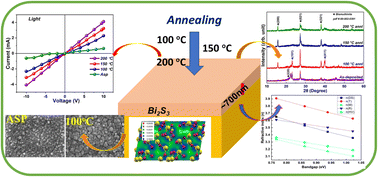
Thermal annealing provides a facile method for tuning the optoelectronic response of semiconductor thin films. In this work, ∼700 nm-thick Bi2S3 thin films prepared by thermal evaporation were subjected to annealing in the range of 100–200 °C, and their structural, optical and photodetection properties were studied. Annealing brings about changes in the crystallinity, surface morphology, and wettability, resulting in a decrease in the bandgap from 1.022 to 0.766 eV with increasing temperature. Crystallinity improves at moderate annealing temperatures (100–150 °C) but worsens at higher temperatures (200 °C) because the lattice becomes more disordered. The refractive index and nonlinear optical parameters, such as nonlinear refractive index and nonlinear absorption coefficient, are found to increase with an increase in the annealing temperature. Photodetector response studies reveal an increase in the responsivity from 0.129 to 0.822 A W−1 and an increase in the specific detectivity from 5.17 × 10⁹ to 1.34 × 10¹⁰ Jones with increasing annealing temperature. The results of density functional theory (DFT) calculations are also presented, which support the experimental results. It is conclusively shown that annealed Bi2S3 thin films can be employed as sensitive visible-light photodetectors.
 Please wait while we load your content...


