


 PLATFORM UPDATE:


Fabrication of Co3O4/P-rGO for electrocatalytic reduction of greenhouse CO2 gas into value-added chemicals in aqueous solution

Abstract
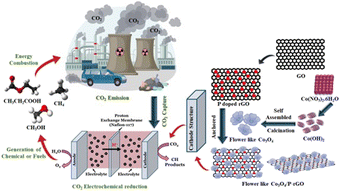
The electrocatalytic reduction of greenhouse CO2 gas into value-added fuels or chemical feedstocks sustainably addresses energy and environmental crises. However, CO2 reduction is particularly effective with electrocatalysts, which exhibit distinct functionality at electrode surfaces. In this work, we demonstrate the electrocatalytic reduction of CO2 using flower-like cobalt oxide (Co3O4) synthesized via a hydrothermal method. Co3O4 is incorporated into P-doped rGO via ultrasonication to form a hybrid electrocatalyst, thereby enhancing CO2 reduction efficiency by improving electrode surface functionality. Chemical, morphological, and structural characterization of the synthesized catalyst was carried out using scanning electron microscopy (SEM), X-ray diffraction (XRD), Raman spectroscopy, and X-ray photoelectron spectroscopy (XPS) analysis. The electrocatalytic reduction of CO2 was performed in 0.5 M NaHCO3 aqueous solution at a pH of 7.5 (CO2 conditions) in a three-electrode system and applying potential vs. Ag/AgCl (3 M KCl sat.) as the reference electrode, platinum wire as the counter electrode, and the prepared catalyst as a modified graphite working electrode. Chronoamperometry shows CO2 conversion stability under a constant voltage of −0.62 V (vs. Ag/AgCl) for 2.5 hours. The Co3O4 catalyst primarily yields ethanoic acid with 69% faradaic efficiency at a current density of −0.5 mA cm−2. Additionally, ethanoic acid and propanal are detected for the hybrid flower-like Co3O4/P-rGO catalyst, with 58% and 9% faradaic efficiencies at a constant current density of −0.8 mA cm−2. These results highlight that incorporating Co3O4 into the P-rGO improves reduction performance. This can provide a promising platform for synthesizing and fabricating shape-based materials as an electrocatalyst, paving the way for a future powered by renewable, boundless energy and wealth from greenhouse CO2 gas and other pollutants.
 Please wait while we load your content...


