


 PLATFORM UPDATE:

Synergistic effect of copper(ii) ions and orthosilicate group in nanosized hydroxyapatite
 †ab
Agata
Piecuch,
c
Paulina
Sobierajska,
†*a
Cole
Latvis,
d
Katarzyna
Szyszka,
a
Oleksii
Bezkrovnyi,
a
Rafał
Ogórek,
c
Yadong
Wang
d
and
Rafal J.
Wiglusz
*ad
†ab
Agata
Piecuch,
c
Paulina
Sobierajska,
†*a
Cole
Latvis,
d
Katarzyna
Szyszka,
a
Oleksii
Bezkrovnyi,
a
Rafał
Ogórek,
c
Yadong
Wang
d
and
Rafal J.
Wiglusz
*ad
Abstract
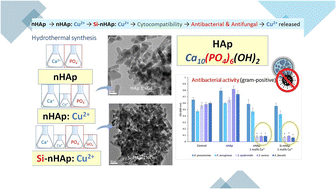
Copper- and silicate-containing hydroxyapatites have attracted increasing attention as potential antimicrobial biomaterials. This paper aims to synthesize nanosized hydroxyapatite-type materials doped with copper(II) ions alone (nHAp: Cu2+) and with orthosilicate groups (Si-nHAp: Cu2+) via a microwave-assisted hydrothermal method followed by sintering at 450 °C. Copper(II) ions were incorporated at the concentrations of 0.1, 0.5, and 1 mol%, while orthosilicate substitution replaced one orthophosphate group in the hydroxyapatite structure. This study focuses on the synergistic influence of cationic (Cu2+) and anionic (SiO44−) substitutions on the composition, morphological features, ion-release behaviour, and biological activity of nanosized apatite materials. We used a wide range of characterization methods and demonstrated both morphological changes of doped hydroxyapatite nanoparticles and selective antimicrobial activity against Gram-positive bacteria. No effects on Gram-negative bacteria or fungi were observed. Silicate ions increase the release of Cu2+ ions from 56% to 98%, thereby enhancing the reduction of Gram-positive bacteria growth. At lower concentrations, the materials showed no cytotoxic effect. Our work clearly shows that synthesized materials with low dopant content exhibit selective antimicrobial activity and can be used to treat infections, targeting Gram-positive bacteria such as S. epidermidis, S. aureus, and E. faecalis.
 Please wait while we load your content...


