


 PLATFORM UPDATE:


Design, synthesis, and anti-inflammatory evaluation of new isatin azo disperse dyes: computational studies, molecular docking, and printing performance on polyester fabrics
 *a
*a
Abstract
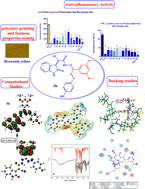
Pharmaceutical and industrial uses of heterocyclic compounds are so varied that they are important for material science and drug discovery. First synthesized in 1841, isatin is a derivative of indole that has garnered significant attention as a structure that is modular for bioactive chemicals. In this study, novel isatin-based azo dyes, namely 2-cyano-N′-(4-hydroxy-3-methoxy)-(E)-(aryl)diazinyl)benzylidene)-2-((Z)-2-oxoindolin-3-ylidene)acetohydrazides (4a–d) and (E)-5-(2-cyano-2-((Z)-2-oxoindolin-3-ylidene)acetyl)-3-(3,5-dimethoxyphenyl)-1-(aryl)formazans (5a–d), were effectively synthesized and their structure was clarified using spectroscopic investigations utilizing mass spectrometry, 1H, 13C NMR, and FT-IR. The colorimetric and fastness characteristics of the dyes, such as their resistance to light, perspiration, washing, sublimation, and rubbing, were assessed after they were applied to printing polyester fabric. An assessment of the anti-inflammatory properties of synthetic isatin azo dyes revealed that almost all of them exhibit anti-inflammatory actions against COX-2, TNF, and IL-6. Additionally, using the 6-311++G(d, p) basis set, density functional theory (DFT) was used to study the isatin azodyes 4a–d and 5a–d. The energy values of the highest filled molecular orbital (HOMO), the lowest unfilled molecular orbital (LUMO), and the MEP were measured to discover more about the reactive regions of the molecules. To illustrate the connection between theory and experiment, FT-IR spectra were calculated for isatin dye molecules. Excellent agreement was established between experimental and theoretical data. In conclusion, every newly created dye has the potential to be an anti-inflammatory. Compounds 4b and 5b were shown to be the most efficient against TNF and IL-6, and theoretical evidence supports these findings. To gain more insights into how compound 5b interacts with TNF (tumor necrosis factor), we used molecular docking tools to predict its affinity within the receptor, providing useful preliminary evidence for drug development. Additionally, docking analysis was performed, and it confirmed the presented results.
 Please wait while we load your content...


