


 PLATFORM UPDATE:


A layered double hydroxide nanocarrier enables YM155 delivery-induced PANoptosis and immunogenic activation in hepatocellular carcinoma
 abcd
abcd
Abstract
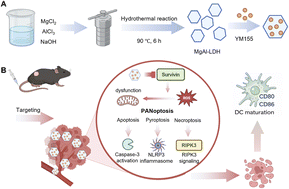
Hepatocellular carcinoma (HCC) remains a highly lethal malignancy due to its intrinsic resistance to apoptosis and limited response to conventional chemotherapy. This therapeutic bottleneck is closely associated with aberrant cell death regulation and an immunosuppressive tumor microenvironment, which collectively restrict effective tumor eradication. In this study, a layered double hydroxide (LDH)-based YM155 delivery platform (LDH-YM155) is developed to enhance Survivin-targeted therapy while simultaneously reprogramming tumor cell death toward an inflammatory and immunogenic phenotype. LDH-YM155 exhibits favorable physicochemical stability, pH-responsive YM155 release, and efficient cellular internalization, triggering pronounced oxidative stress and mitochondrial membrane depolarization in Hepa1-6 cells. This stress cascade activates PANoptosis characterized by elevated caspase-3, caspase-8 and caspase-1 activity, ASC speck formation, elevated p-MLKL levels, increased Annexin V/PI-positive populations, and upregulated NLRP3 and RIPK3 signaling. In parallel, LDH-YM155 induces immunogenic cell death-associated events, including enhanced calreticulin exposure, extracellular HMGB1 and ATP release, and increased lactate dehydrogenase release, thereby promoting dendritic cell maturation through tumor cell-conditioned media. Transcriptomic profiling further confirms activation of stimulus-responsive and inflammatory signaling pathways consistent with the observed phenotype. In vivo, LDH-YM155 demonstrates improved tumor accumulation and significantly suppresses tumor growth in a Hepa1-6 tumor-bearing mouse model, accompanied by reduced Ki-67 expression and increased TUNEL staining. Importantly, tumor tissue staining validates elevated NLRP3, RIPK3, and CRT signals with reduced HMGB1 retention, supporting the induction of inflammatory and immunogenic tumor cell death in vivo. Further immune profiling revealed enhanced dendritic cell maturation, pro-inflammatory macrophage polarization, and increased cytotoxic CD8+Granzyme B+ T-cell activation within the tumor microenvironment. Collectively, this LDH-based nanotherapeutic strategy enhances YM155 efficacy by coupling Survivin inhibition with PANoptosis activation and ICD-associated immune stimulation, providing a promising platform for hepatocellular carcinoma therapy.
 Please wait while we load your content...


