


 PLATFORM UPDATE:


Synthesis, characterization, in vitro and in silico studies of novel lophine clubbed acylthioureas

Abstract
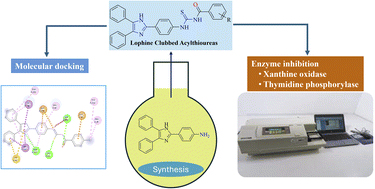
In the present study, a chemical library of novel lophine clubbed acylthioureas (8a–l) was designed and synthesized through a multistep sequence. 2-(4-Nitrophenyl)-4,5-diphenyl-1H-imidazole (3) was synthesized from benzil, 4-nitrobenzaldehyde, and ammonium acetate via multicomponent reaction. Then the nitro group of the synthesized compound was reduced using zinc and hydrochloric acid to furnish 4-(4,5-diphenyl-1H-imidazol-2-yl) aniline (4). On the other hand, the acid chloride (6a–l) of substituted benzoic acids was prepared by reacting acids (5a–l) with thionyl chloride, followed by their reaction with potassium thiocyanate to afford corresponding acyl isothiocyanates (7a–l), which were further reacted with 4-(4,5-diphenyl-1H-imidazol-2-yl)aniline (4) to produce acylthioureas (8a–l) in good yield. The synthesized series (8a–l) was characterized by using a combination of spectroscopic techniques, including FT-IR, 1H NMR, and 13C NMR. Moreover, the synthesized acylthiourea derivatives were assayed for their in vitro and in silico xanthine oxidase and thymidine phosphorylase inhibitory activities. In the tested series, compounds 8j, 8d, and 8i showed robust dual inhibition profiles in low micromolar ranges. Among them, compound 8j revealed the most potent activity, with IC50 values of 1.87 ± 0.26 µM against xanthine oxidase and 1.62 ± 0.27 µM against thymidine phosphorylase. Compound 8d sits in the next position, with an IC50 value of 3.34 ± 0.37 µM (xanthine oxidase) and 3.31 ± 0.06 µM (thymidine phosphorylase), while compound 8i demonstrated considerable xanthine oxidase inhibition with an IC50 of 2.06 ± 0.36 µM. These values have outperformed the standard drug allopurinol (IC50 = 7.4 ± 0.07 µM), which was found to be less potent against xanthine oxidase. Considering the established involvement of these enzymes in oxidative stress, hyperuricemia, and inflammation-based disorders, the results endorse the idea of these derivatives being promising multifunctional therapeutic agents in the treatment of metabolic, inflammatory, and neoplastic diseases.
 Please wait while we load your content...


