


 PLATFORM UPDATE:


Synthesis and preliminary assessment of fluorescent probes based on the competitive GPCR antagonists vismodegib and masupirdine
 a
Tsz-Lam
Cheung,
a
Chowan Ashok
Kumar,
a
Catherine H. H.
Hor,
a
Huishan
Li,
a
Xiuzhi
Zou
a
and
David
Parker
*a
a
Tsz-Lam
Cheung,
a
Chowan Ashok
Kumar,
a
Catherine H. H.
Hor,
a
Huishan
Li,
a
Xiuzhi
Zou
a
and
David
Parker
*a
Abstract
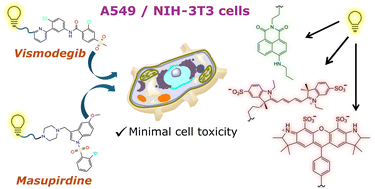
A series of six new fluorescent probes has been synthesised based on vismodegib, a leading antagonist for the G-protein coupled receptor smoothened, and the potent and selective 5-HT6 (serotonin) receptor antagonist, masupirdine, that bind with nanomolar affinities to the endogenous receptors. The X-ray structure of masupirdine has been determined at 100 K; it crystallises in the monoclinic system in space group P21/c. Each compound in the series of red and green fluorescent dyes showed no significant toxicity when administered to NIH-3T3 and A549 cells at sub-micromolar concentrations. Two neutral naphthalimide conjugates of vismodegib, exhibited fast and non-specific cell uptake and showed no tendency to localise in the mitochondria or lysosomes, as determined by live cell imaging experiments using confocal microscopy. In contrast, a masupirdine–naphthalimide conjugate showed a rapid and pronounced staining of the lysosomes, at 25 nM probe concentrations within 15 minutes. The anionic conjugates based on Alexa-532 and cyanine-5 fluorophores showed no cell uptake and bound more weakly to a non-specific protein, as required for their potential use as fluorescent probes that target the GPCRs.
 Please wait while we load your content...


