Issue 22, 2026, Issue in Progress

Fluorine-engineered two-dimensional covalent organic frameworks for enhanced C2H2/CO2 separation

Abstract

Efficient separation of C2H2 from CO2 remains a significant challenge owing to their closely matched molecular dimensions and physicochemical properties. Developing adsorbents capable of discriminating between these two gases is therefore of considerable importance for acetylene purification. Herein, we report two isoreticular two-dimensional covalent organic frameworks (COFs), TP-TFPB-COF and TP-NFPB-COF, featuring an hcb topology and constructed via [3 + 3] imine condensation. By increasing the fluorine content within the framework, TP-NFPB-COF exhibits enhanced C2H2/CO2 separation performance, delivering an IAST selectivity of 2.86 at 298 K and 1 bar, compared with 2.04 for TP-TFPB-COF. Grand canonical Monte Carlo simulations reveal that the improved selectivity arises from increased pore polarity and strengthened C–H⋯F interactions with C2H2 molecules. This work highlights fluorination as an effective strategy for tuning pore environments and advancing COF-based acetylene separation.
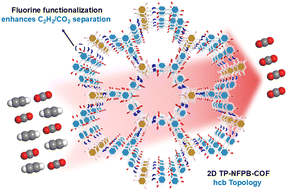
Graphical abstract: Fluorine-engineered two-dimensional covalent organic frameworks for enhanced C2H2/CO2 separation

Supplementary files

Article information

Article type
Paper
Submitted
10 Feb 2026
Accepted
11 Apr 2026
First published
17 Apr 2026
This article is Open Access
Creative Commons BY-NC license

RSC Adv., 2026,16, 19969-19973

Fluorine-engineered two-dimensional covalent organic frameworks for enhanced C2H2/CO2 separation

J. Liu, W. Wei, S. Wang, P. Hao, W. Zhang and Y. Peng, RSC Adv., 2026, 16, 19969 DOI: 10.1039/D6RA01174H

This article is licensed under a Creative Commons Attribution-NonCommercial 3.0 Unported Licence. You can use material from this article in other publications, without requesting further permission from the RSC, provided that the correct acknowledgement is given and it is not used for commercial purposes.

To request permission to reproduce material from this article in a commercial publication, please go to the Copyright Clearance Center request page.

If you are an author contributing to an RSC publication, you do not need to request permission provided correct acknowledgement is given.

If you are the author of this article, you do not need to request permission to reproduce figures and diagrams provided correct acknowledgement is given. If you want to reproduce the whole article in a third-party commercial publication (excluding your thesis/dissertation for which permission is not required) please go to the Copyright Clearance Center request page.

Read more about how to correctly acknowledge RSC content.

Social activity

Spotlight

Advertisements